
Shopify will tax return shipping fees from October 23. Check for double tax
From October 23, 2026, Shopify Tax calculates tax on US return shipping fees automatically. If you patched that by hand, you may now count it twice.
On October 23, 2026, Shopify starts calculating tax on return shipping fees for US returns. In its own words: “Return shipping fees will be taxed like any other shipping charge. Shopify calculates and applies the tax automatically.”
For most stores this is a non-event, and Shopify says so plainly: “If you don’t use a manual workaround today, no action is required.”
The stores that need to act are the careful ones — the merchants who noticed, some time ago, that these fees were showing up with $0 tax and built a fix. On October 23 that fix and Shopify’s new behavior run at the same time.
What changes
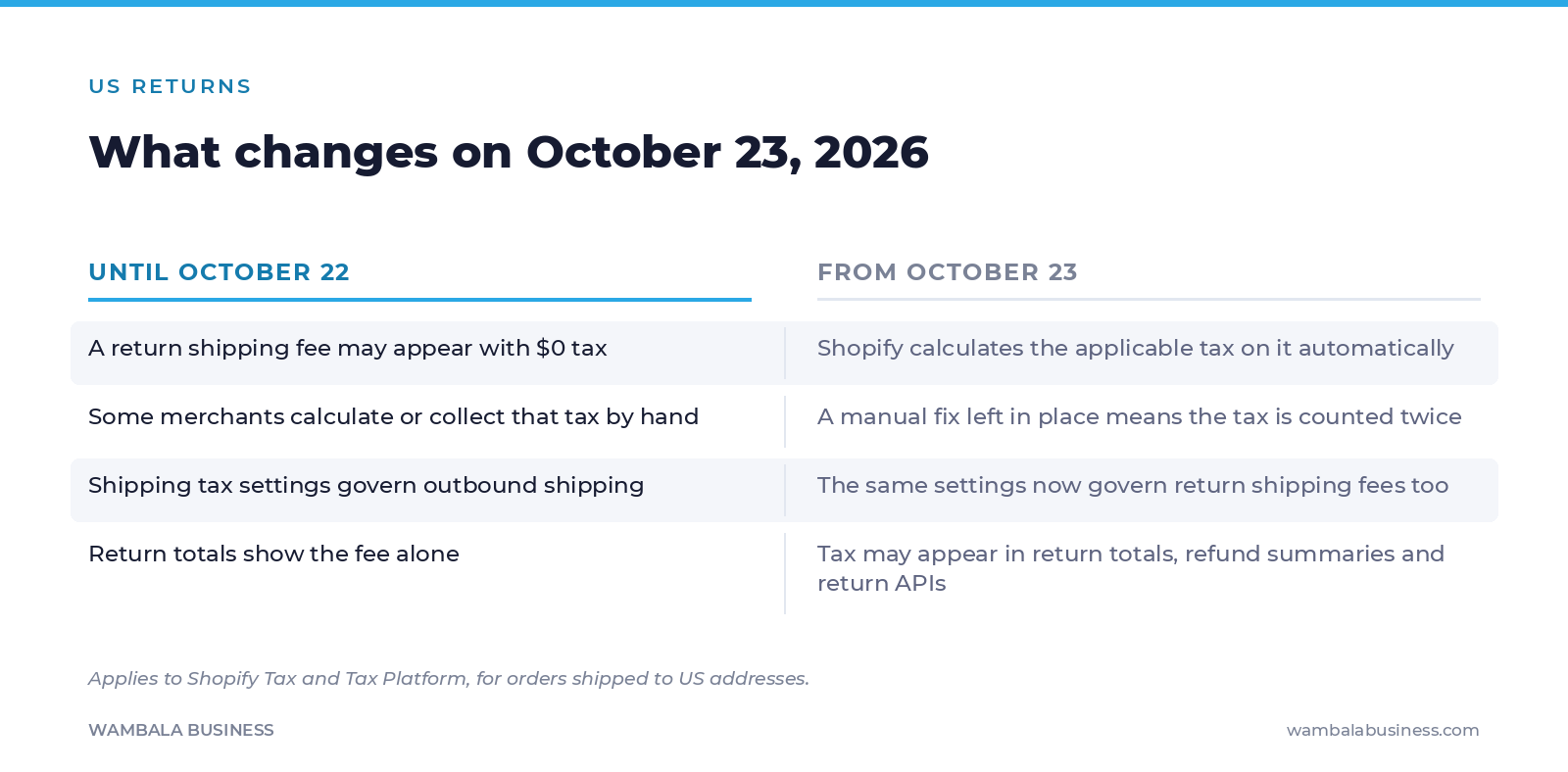
The change applies to “merchants using Shopify Tax or Tax Platform in the United States,” for “orders shipped to US addresses.” Shopify’s instruction to anyone with a manual process is specific: “If you use a manual workaround today to calculate, collect, import, or reconcile tax on return shipping fees, review it before October 23 to avoid double-counting tax.”
Read those four verbs as four different places a workaround can live: a line someone adds by hand, an amount collected separately, a spreadsheet import, or a month-end reconciliation step. The last two are the ones people forget they have.
The setting that now does two jobs
One sentence in Shopify’s announcement deserves more attention than it is getting: “Your existing shipping tax settings still apply — if you’ve set shipping to be untaxed in a state, return shipping fees in that state remain untaxed.”
That is reassuring, and it is also a dependency. The shipping tax settings you configured for outbound orders — possibly years ago, possibly by someone who no longer works with you — now decide how return fees are taxed as well.
If those settings are right, you inherit correct behavior for free. If they are stale, you inherit that too, on a second type of transaction. Either way, they are worth opening before the 23rd.
What is in scope, and what nobody has said
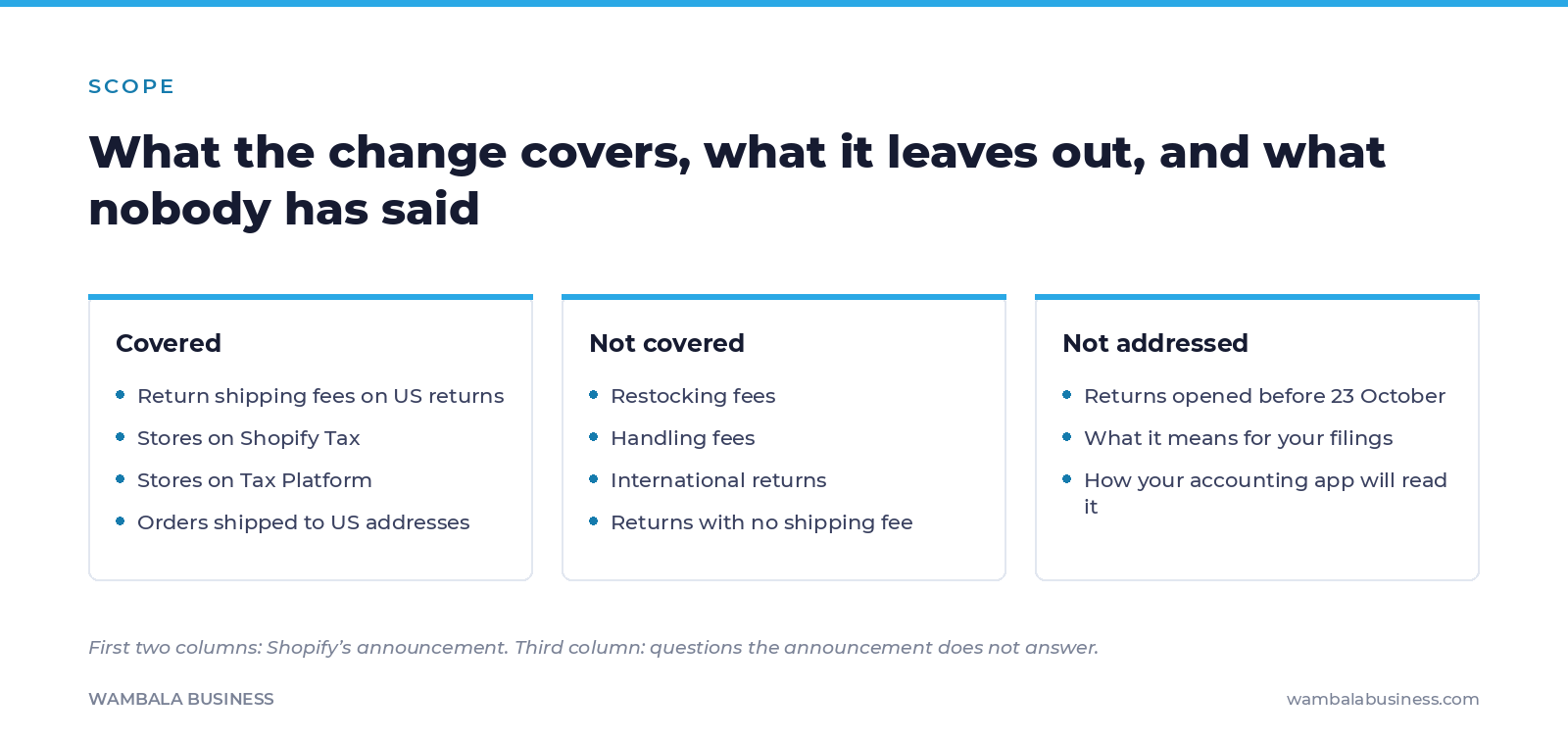
Shopify staff were clear about the exclusions: restocking fees, handling fees, international returns, and returns without a shipping fee are not part of this.
The gaps are worth stating as gaps:
- Returns already open on October 23. The announcement does not say how a return created before the date and completed after it is treated.
- Your filings. Shopify says tax “may appear in return totals, refund summaries, and supported return APIs.” What that means for what you report and remit is not something a changelog can tell you.
- Everything that reads your return data. A returns app or an accounting connector that pulls from those APIs will start seeing a tax amount where there was none. Whether it handles that correctly is a question for each vendor.
We are not tax advisers, and this is not tax advice. Whether return shipping fees are taxable in a given state, and how they should be reported, is a question for your CPA. What we can tell you is the mechanical part: what Shopify will start doing, which settings it follows, and where a manual fix can collide with it.
The check, in order
- Ask whoever does your books one question: “Do we do anything by hand for tax on return shipping fees?” If the answer is no, Shopify says you are done.
- If the answer is yes, find all four forms of it — calculating, collecting, importing, reconciling — and decide which ones stop on October 23.
- Open your shipping tax settings state by state. They now govern return fees too.
- Ask your returns app and your accounting connector how they will treat a tax amount on return shipping fees. Get the answer in writing.
- Reread your returns policy page. If it tells customers exactly how much comes off a refund, that number may change by the tax. And that page is no longer read only by people: it is what an AI agent quotes when a shopper asks about returns, as we covered in the piece on agent-callable storefronts.
- Run one test return after the 23rd and look at the refund summary before the first real one reaches a customer.
Why we keep writing about quiet dates
This is the second change this month that arrives without an error message. On October 1, Shopify froze the creation of script tags while leaving existing ones running until March. Now a tax calculation switches on by default.
Neither one is a problem if someone knows it happened. Both are the kind of thing that surfaces three months later as a number that does not reconcile — and by then nobody remembers the date.
We do not do your taxes. We build and run the store, and part of that job is knowing which defaults moved. If you want a second pair of eyes on how yours is configured, the first round of our technical audit is free. If you would rather have it built properly from the start, this is how we build Shopify stores.
Verified October 6, 2026 against Shopify’s changelog and the announcement by Shopify staff in the Shopify Community. The treatment of returns opened before October 23 and the effect on tax filings are not addressed in either source.
Sources: Shopify Changelog — Tax is now calculated on return shipping fees · Shopify Community — Update to taxes on US return shipping fees, coming October 23, 2026
Forty-eight hours, everything public about your brand, zero sales deck.
Leave your email and we will send you the report. We tell you what we find, whether or not it leads to hiring us.
The signup form needs marketing cookies, which you have not accepted yet. You can enable them from the cookie notice, or simply write to us: