
Shopify made your storefront agent-callable on August 5. You did not install it
Every Liquid storefront now exposes ten WebMCP tools that let an AI agent search your catalog, change the cart, head to checkout and answer policy questions on your behalf. Nothing to configure, and one of those tools deserves your attention today.
On August 5, 2026, Shopify shipped something to your store without asking. Its developer changelog puts it plainly: “Online stores now expose WebMCP tools that AI agents can call. Agents can search your catalog, manage the shopper’s cart, and go to checkout on the shopper’s behalf, all in the tab they’re looking at.”
And then the sentence that matters: “The tools are live today on every Liquid storefront and on the Hydrogen developer preview. There’s nothing to install or configure.”
This is not the same thing as the agentic storefronts we wrote about earlier, and conflating them is the first mistake people are making.
The ten tools
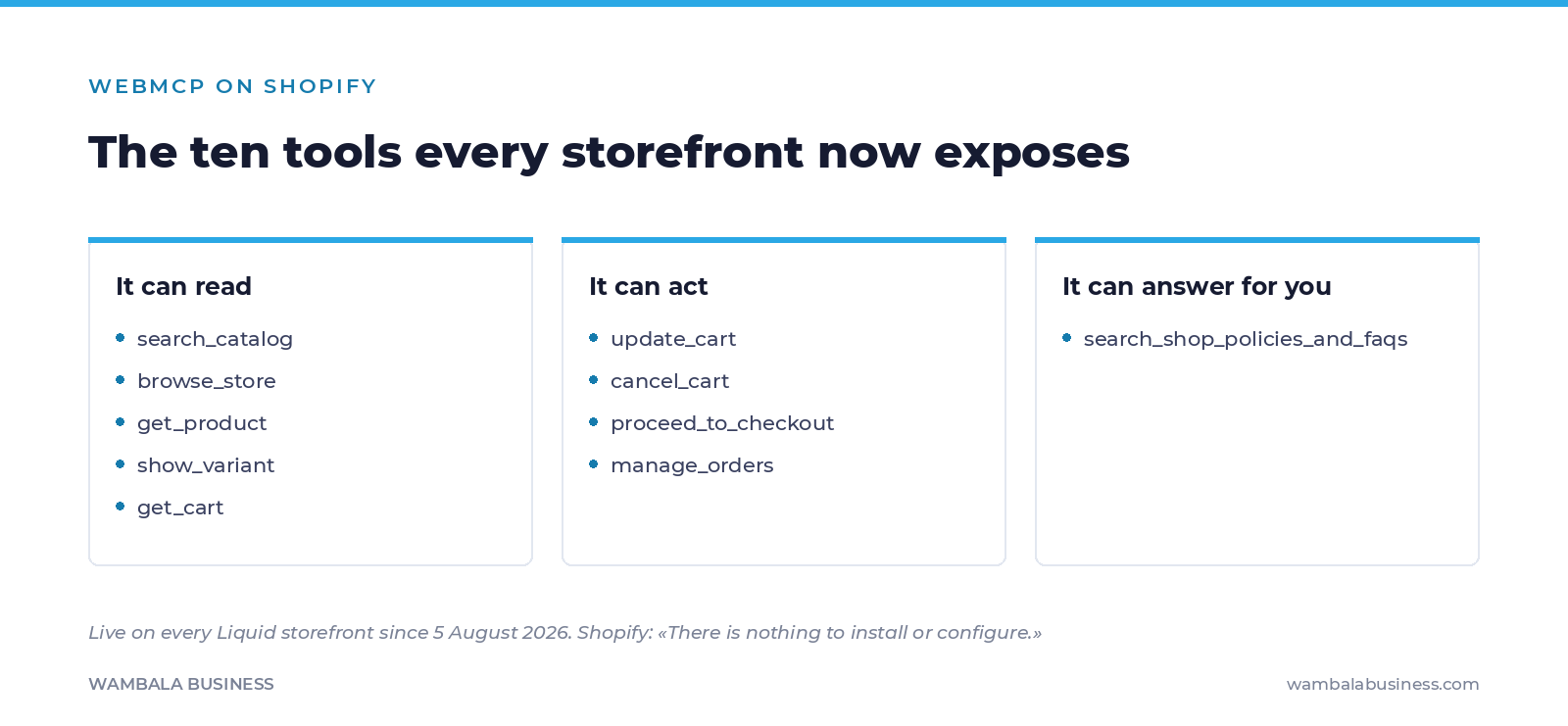
update_cart and proceed_to_checkout is a shopper acting on someone's behalf.Shopify documents each one. search_catalog searches “products, collections, articles, and pages.” get_product returns “full details for a product, including variants, prices, and which option combinations are in stock.” update_cart can “add items to the cart, change quantities, or remove items.” proceed_to_checkout takes the shopper to checkout “after verifying the cart isn’t empty.”
None of this requires the shopper to leave your site. That is the whole point of the in-tab model.
Two different doors, and they are not interchangeable
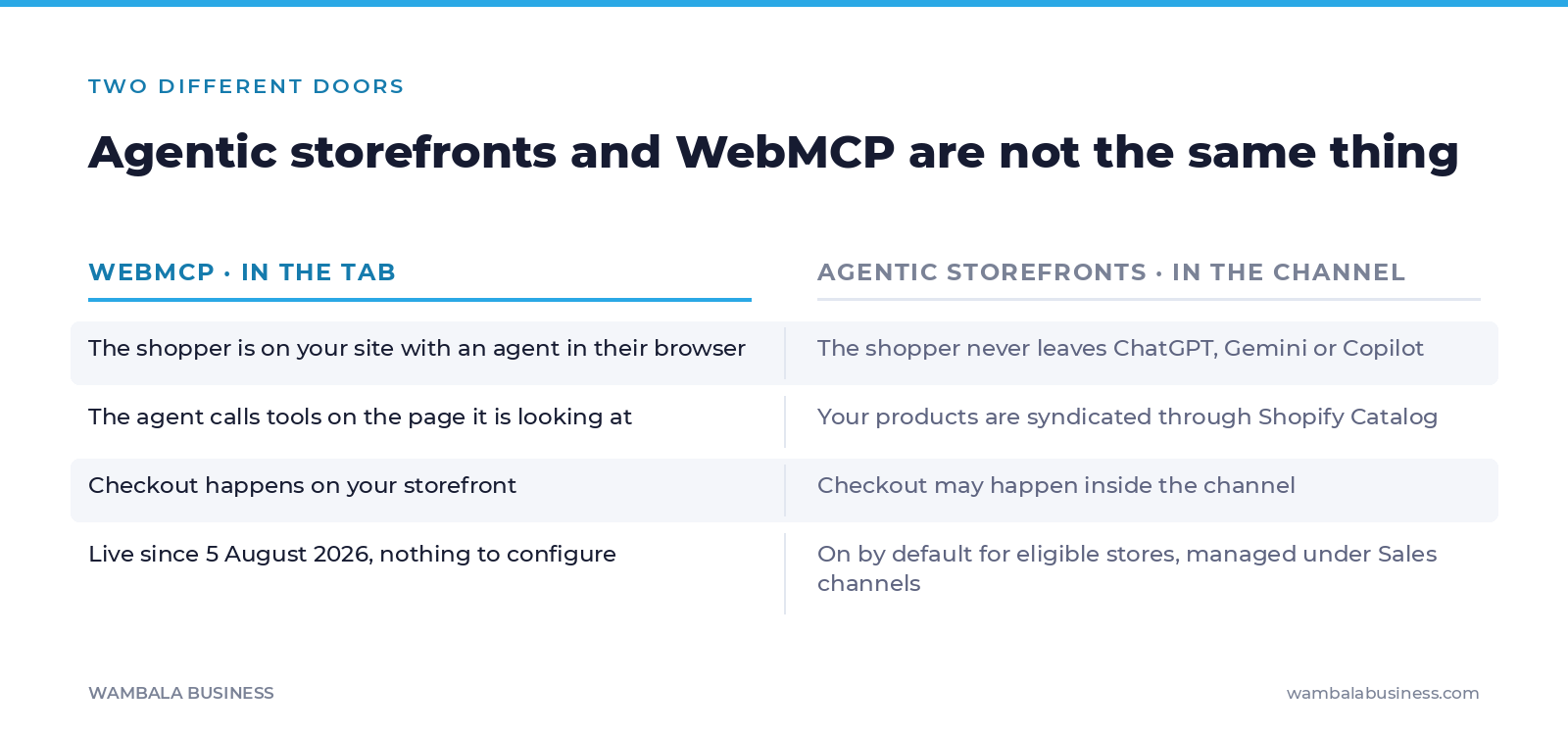
If you have been working on agentic storefronts and the AI channels, that work is about being discoverable inside ChatGPT, Gemini, Copilot and Meta — your products syndicated through Shopify Catalog. WebMCP is the opposite direction: the shopper is already on your site, with an agent in their browser, and your storefront hands that agent a set of callable tools.
Both are live. Neither replaces the other. And the second one arrived without a settings screen.
The tool nobody is talking about
Of the ten, search_shop_policies_and_faqs is the one we would look at first. Shopify describes it as answering “questions about the store’s policies and services, such as returns, shipping, and hours of operation.”
Read that as an operator, not as a developer.
Your policy pages now speak for you, unsupervised. When a shopper asks an agent "can I return this if it doesn't fit?", the agent does not guess — it calls this tool and answers from your published policy. If that page is vague, outdated, or contradicts what your team tells people on chat, the agent will confidently relay the wrong thing. And it will do it in a context where nobody from your side is watching.
For years, a sloppy returns page cost you a little friction and a few support tickets. Now it is an answer engine with your name on it. That is a genuine change in what those pages are for, and it costs nothing to fix.
What we would actually check this week
None of this is a project. It is an afternoon.
- Read your own policy pages as if you were a stranger. Returns window, who pays return shipping, what happens with a damaged item, delivery times by region. If a sentence is ambiguous to you, it is ambiguous to an agent.
- Reconcile the pages with what your team actually says. The most common gap we find is a written 30-day policy that support informally stretches to 60. Pick one and publish it.
- Check that product data supports
get_product. Variants, prices and stock per option combination are exposed. Wrong or missing variant data now surfaces in a conversation, not just on a page. - Make sure your shipping information is on a page, not only in the checkout. A tool that searches policies cannot read a cost that only appears at step three of checkout.
- Open your top product page and read its description out loud. If it does not answer material, size and fit, an agent cannot answer them either.
You will notice this is the same list we give people for being findable by AI assistants at all. That is not a coincidence — it is the point. The work that makes your store legible to a machine is the same work that makes it legible to a person in a hurry.
What we do not know yet
We want to be careful here, because there is a lot of confident writing about this and not much evidence.
Shopify’s documentation does not describe an off switch. It says there is nothing to install or configure; it does not say whether a merchant can disable the tools or add custom ones. We are not going to tell you it cannot be turned off — only that we could not find it documented. If that matters to you, ask Shopify directly rather than trusting a blog post, this one included.
There is no data on how much traffic this represents. In-tab browser agents are new. Anyone quoting you a share of sessions is guessing. The reason to act is not projected volume — it is that the cost of fixing your policy pages is roughly zero and the downside of an agent misquoting your return terms is not.
Attribution is unclear. A sale where an agent filled the cart and the shopper checked out on your storefront looks, in your reports, like an ordinary session. Do not expect a tidy line item.
The part that is actually strategic
For a decade, the thing you optimized was a page a person would look at. Then it became a catalog a machine would read somewhere else. Now it is a set of functions a machine can call while standing on your own site.
The through-line is the same each time: structured, accurate, unambiguous information about what you sell and how you sell it. Stores that had that already are fine. Stores that relied on a human reading between the lines are not.
If you want us to look at whether your storefront actually answers those questions, the first round of our technical audit is free. If you would rather have it built right from the start, here is how we build Shopify stores and how we work on AI visibility.
Verified September 15, 2026. Quotes and tool names come from Shopify’s developer changelog and WebMCP documentation.
Sources: Shopify — WebMCP support for Liquid and Hydrogen storefronts · Shopify — WebMCP tools
Forty-eight hours, everything public about your brand, zero sales deck.
Leave your email and we will send you the report. We tell you what we find, whether or not it leads to hiring us.
The signup form needs marketing cookies, which you have not accepted yet. You can enable them from the cookie notice, or simply write to us: