
ChatGPT ads: what a US store should know before spending on them
OpenAI put ads in ChatGPT, and a self-serve manager followed. Here is who actually sees them, what the platform hands an advertiser, and the three reasons this behaves nothing like Meta.
A new paid channel does not show up often. When one does, the useful question is never “should I be on it” — it is “what does this thing actually do, and what does it hand me back.”
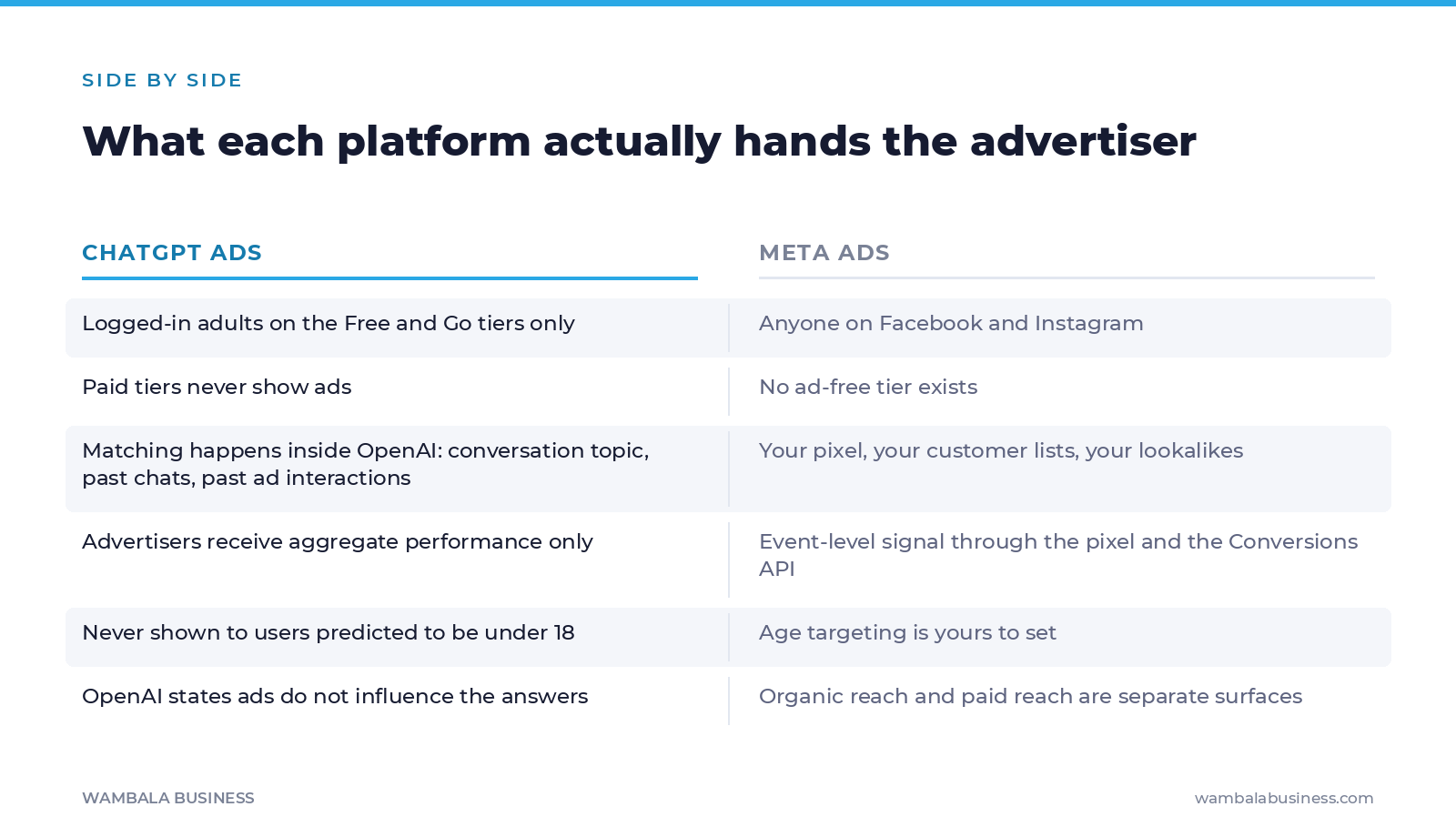
OpenAI began testing ads in ChatGPT on February 9, 2026. Ads are, in OpenAI’s own words, “clearly labeled as sponsored and visually separated from the organic answer,” and they appear for logged-in adult users on the Free and Go subscription tiers. Plus, Pro, Business, Enterprise and Education tiers do not have ads at all.
That last sentence is the one to sit with before you budget anything.
How it got here
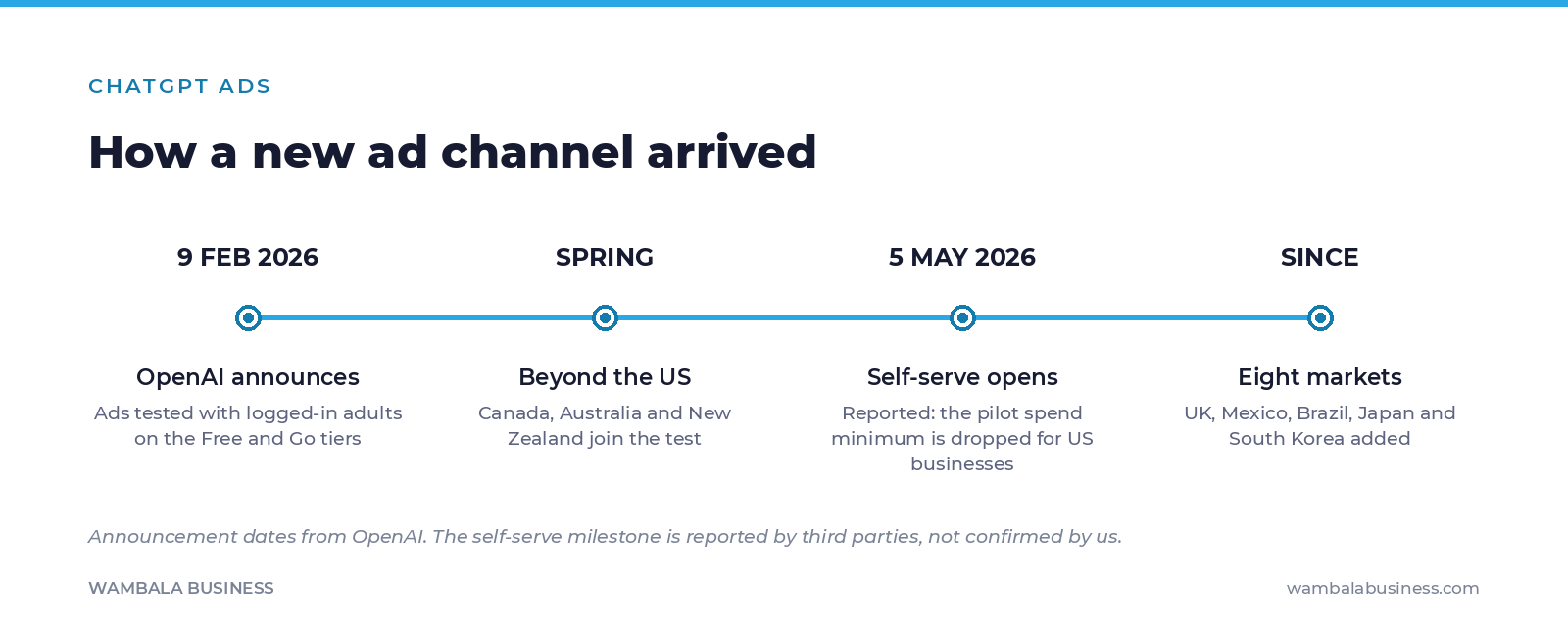
The channel started in the United States and expanded to Canada, Australia and New Zealand, then to the United Kingdom, Mexico, Brazil, Japan and South Korea. If you sell into any of those, this is live inventory near your customers.
The three things that make it behave nothing like Meta
1. You do not bring your own targeting
On Meta, the targeting is substantially yours: your pixel, your customer lists, your lookalikes. On ChatGPT, matching happens inside OpenAI, using “the topic of your conversation, your past chats, and past interactions with ads.”
You are not uploading an audience. You are describing what you sell and trusting a matching system you cannot inspect. That is not automatically worse — Meta has been moving the same direction for years — but it is a different job. The lever you have is your creative and your offer, not your segments.
2. You do not get event-level signal back
Advertisers “do not have access to your chats, chat history, memories, or personal details” and receive “aggregate information about how their ads perform.”
Aggregate. Not per-user, not per-event.
This matters more than it sounds. Everything you know about attributing a Meta campaign — matching a click to a session to a purchase — does not transfer. You will be reasoning about incrementality from totals, which is a real discipline but a slower and blunter one. If your entire measurement practice depends on event-level joins, budget for the fact that this channel will look worse than it is, simply because you can see less of it.
3. The context is a conversation, not a feed
A person in a feed is browsing. A person mid-conversation asked a question and is waiting for an answer. Interrupting that with a mismatched ad is a worse experience than a mismatched ad in a feed, and OpenAI states plainly that “ads do not influence the answers ChatGPT gives you” — meaning you cannot buy your way into the recommendation itself.
Which leads to the thing worth being blunt about.
Buying ads does not make an assistant recommend you. The sponsored slot and the organic answer are separate, by OpenAI's own statement. If someone is selling you ChatGPT advertising as a route to being named in the answer, they are describing something that does not exist. Getting named in the answer is a different discipline entirely — we wrote about why brands are invisible to ChatGPT after discovering our own agency was.
Side by side
What we would actually do about it
We are not going to tell you to move budget into a channel that is months old and reports in aggregate. We are also not going to tell you to ignore a surface where a large share of commercial questions now get asked. Both of those are lazy.
If you are already efficient on Meta and want to test: carve out a small, explicitly experimental budget with a fixed end date, and judge it on total incremental revenue over the test window — not on a per-click number you cannot construct. Decide the success threshold before you start, because aggregate reporting makes it very easy to argue either side afterwards.
If your Meta account is not clean: do not test anything. A second channel does not fix a first channel that is optimizing on bad data, it just adds a place to lose money. That is not a sales line — it is why we do not run paid traffic to stores that are not built properly.
If your customers are mostly professionals paying for ChatGPT: this channel cannot reach them at all. Spend the energy on being the answer instead of buying the slot beside it.
Everyone: the copy discipline here is unusually strict. A visual ad card gives you a headline of well under a hundred characters. If your value proposition needs a paragraph, it will not survive the format — which is useful diagnostic information about the value proposition, not just the ad.
What nobody can tell you yet
There is no meaningful public benchmark data for this channel. Anyone quoting you a confident CPC or ROAS is extrapolating from a handful of accounts, a short window, and categories that may be nothing like yours. The pricing figures circulating in agency blogs come from third parties, not from OpenAI’s published material, and we are not going to repeat them as fact.
What is verifiable is the shape of the thing: who sees it, what signal you get, and what the platform says it will not do. That is enough to decide whether it belongs in your plan this quarter. It is not enough to build a forecast on, and you should be suspicious of anyone who says otherwise.
If you want a straight read on whether your Meta account is clean enough to be testing anything else, the first round of our technical audit is free. If you would rather fix the foundation first, here is how we build Shopify stores and how we run Meta Ads on measurement we trust.
Verified September 7, 2026. Rollout details and policy statements come from OpenAI’s published page. The self-serve access date and any pricing figures reported elsewhere are not verified by us — confirm them with OpenAI before committing budget.
Sources: OpenAI — Testing ads in ChatGPT · Segwise — ChatGPT Ads in 2026: the complete guide for marketers
Forty-eight hours, everything public about your brand, zero sales deck.
Leave your email and we will send you the report. We tell you what we find, whether or not it leads to hiring us.
The signup form needs marketing cookies, which you have not accepted yet. You can enable them from the cookie notice, or simply write to us: